Wednesday, December 15, 2010

Nissan Concept Cars iv Concept Forward to 2035

Nissan Concept Cars iv Concept Forward to 2035
Created by Nissan Design America for the 2010 LA Design Challenge, a competition that has asked automotive producers from around the world to create eco-conscious vehicles with a top design that weigh less than 1,000 pounds (454 kg).
In 2010, Nissan launched an innovative LEAF as the first mass production electric vehicle in the world, as well as a beginning for the future vision of zero emissions Nissan. Forward to 2035: electric vehicles and green technology infrastructure which matured into a fully sustainable dream, that brings to life.
Using industry-leading technology, Nissan iV maximize the driving experience by eliminating excess. Nissan makes deep longing and joy of driving with EV that can offer exciting and strikingly beautiful, fast performance with zero fault.
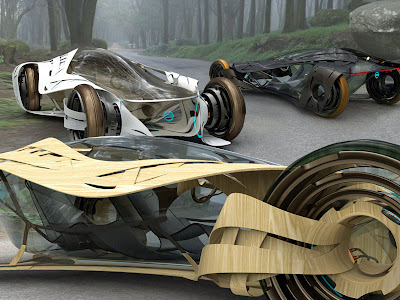
Infused with Nissan’s heritage of sports cars and performance, Nissan Concept Cars iv Concept Forward to 2035 is a high-performance EV inspired by nature’s intelligent beauty and crafted by human ingenuity. The iV is a super-lightweight sports cars tourer that showcases “organic synthetics,” a revolutionary manufacturing technique in which automotive parts are cultivated like agriculture in a 100% sustainable, carbon-neutral process.
Nissan Concept Cars iv Concept Forward to 2035
Every detail is engineered toward renewable, lightweight strength and maximum efficiency. Featuring an interwoven organic frame, the chassis material is synthetically grown and formed into an aerodynamic shape.
The car seats four and features a photo-voltaic rooftop, a slim bio-battery provides stability and regenerative capacitor technology that recoups 60% of kinetic energy spent.
Nissan Concept Cars iv Concept Forward to 2035
The vehicle is powered by concentric hub-less in-wheel electric motors, which also acts as a suspension and steering, using magnetic levitation and propulsion. Concentric magnetic rings amplify rotation with each outer ring to boost high-speed performance and provide independent wheel control for ultimate handling and maneuverability.
Nissan’s president Carlos Ghosn has publicly said that the company’s success depends on its ability to develop and deploy electric vehicles that excite the masses. The iV is part of Nissan’s zero emissions future. The Renault/Nissan partnership with Better Place will result in more than 100,000 battery-swap enabled sedans on the road in Israel and Denmark, with cars and charging infrastructure slated for Toronto, Hawaii and the San Francisco Bay Area.
Nissan Concept Cars iv Concept Forward to 2035

Thursday, December 9, 2010

Honda Air Concept Cars Powered By A Compressed Air And Pneumatic Regulator System

Honda Air Concept Cars Powered By A Compressed Air And Pneumatic Regulator System
The Honda Air is a new vehicle concept created for the 2010 LA Design Challenge by Honda’s Advanced Design Studio in Pasadena, California. The Honda Air Concept Cars is defined as “a vision of the future of lightweight and alternative fuel performance vehicles”.
The company's designers took inspiration from roller coasters and skydiving wind suits. Inspired by the modern roller coaster as well as skydiving wing-suits, the Air is powered by a compressed air and pneumatic regulator system.
This system ‘utilizes turbo vacuums and external air-flow to regenerate tank pressure for extended range and increased boost for an estimated 100 miles’. to keep the car lightweight, all components are mounted directly to the chassis, eliminating unnecessary structures. With a chassis composed of vegetable-based polymer panels, the vehicle weighs a mere 800 pounds and its reserve tanks can be filled via a gas station tire filler or a common off-the-shelf air compressor.
Honda Air Concept Cars Powered By A Compressed Air And Pneumatic Regulator System
The Air’s cockpit and package is aimed at maximizing the open air experience. In order to save weight and increase performance, a hub-less wheel and drive system eliminates the use of heavy drive train components. Additional weight savings are achieved thanks to the glass reinforced seating panels, urethane tire composition and skeletal sub-frame components. The main tanks and reserves can be filled quickly and safely using a simple generator / air compressor at home or a tire filler at the local filling station.
Honda Air Concept Cars Powered By A Compressed Air And Pneumatic Regulator System
To minimize weight to just under 800 lbs, the powerful anthem of pneumatic propulsion and a character unlike any zero-emission vehicle exemplifies Honda's concept of fun to drive. The pow[air] of dreams.
Overall design and look of Honda Air Concept Cars Powered By A Compressed Air And Pneumatic Regulator System paves way for futuristic cruiser cars that have the perfect combo of style, ride elation and most importantly zero-emission properties combined with ample power under the hood to set your heart beat racing.
Honda Air Concept Cars Powered By A Compressed Air And Pneumatic Regulator System

Sunday, December 5, 2010

Amphibious Sports Cars Gibbs aquada Concept Cars

Amphibious Sports Cars Gibbs aquada Concept Cars
The Aquada, developed by Alan Gibbs, and marketed by Gibbs Technologies, represents state of the art amphibious car design. Since 1968, numerous prototype amphibious cars have been made, but none gained market traction. Advances in technology in numerous fields have helped Alan Gibbs' Aquada become perhaps the most commercially viable amphibious car since the Amphicar.
Amphibious cars are not just the dreams of moviemakers, although an amphibious car was featured in the movie Pontiac Moon. The concept Amphibious Sports Cars Gibbs aquada Concept Cars, now a very real version of an amphibious car has been released in the UK. The Gibbs aquada high-speed amphibian (HSA) is capable of speeds up to 100mph (160kmh) on land and 30mph (48kmh) over water, taking just six seconds to transform from road going sportscar to a jet powered marine vessel.
Amphibious Sports Cars Gibbs aquada Concept Cars
Gibbs is marketing the Aquada as the 'ultimate leisure vehicle,” and it might be just that. It's as fast as a conventional car on macadam and it can pull a skier on water. The Aquada is sleek, and jet-propelled, recalling the Stalwart, but boasting 60 new patents for its design. Computer systems retract the Aquada's wheels in the water, eliminating their drag.
The aquada is powered by a 175hp, V6 engine with 4 speed automatic transmission that's linked to the fully-enclosed jet propulsion system when on the water. Getting into the water is as simple as driving down a boatramp or entering directly from shore and once the push-button transformation has taken place, the accelerator becomes the throttle and the jet propulsion takes over.
Amphibious Sports Cars Gibbs aquada Concept Cars
The aquada is designed to meet European road and marine safety standards and is fully-legal for both water and land use in the UK according to the Gibbs Technologies site. To meet its lofty speed goals, the Aquada uses a carefully shaped outer body supported inside by a metal space frame. In this is conceptually similar to integrating a NASCAR racer's rollcage into a load-distributing unibody structure as used in a typical sedan.
Propulsion in the ten Aquada prototypes currently testing in Michigan is from a 2.5-liter 160-horsepower engine. Gibb's press materials are careful not to specify precisely which engine this may be, but we assume a turbocharged four cylinder would provide the necessary combination of power and weight (a 175-horsepower V6 is used in the euro-spec Aquada).
Amphibious Sports Cars Gibbs aquada Concept Cars
A take-off from the transmission powers a carefully designed water jet for marine propulsion; Gibbs says the compact jet produces nearly a ton of thrust at half the size and a quarter of the expected weight. It's enough for the Aquada to have set a 32.8 mph record speed run, and sufficiently reliable for Sir Richard Branson to break the amphibian speed record across the English Channel by four hours. More prosaically, Gibbs demonstration video shows the Aquada pulling a water skier.
While we have not piloted an Aquada, it's clear that its driver-center, three-across seating, no doors and Bimini top will have practical considerations, or at least provide numerous conversation starters. On land we'd assume the Aquada would deliver more than acceptable road handling and middling performance given the moderate power and 3,225 lbs. weight.
Amphibious Sports Cars Gibbs aquada Concept Cars
"Our plans for North America are ambitious, aggressive and achievable," Gibbs has said, stating, "Aquada could generate annual sales volumes of 100,000 or more within five years." Perhaps we should get our driving gloves and water skis ready now.

Opel Icona Concept Amphibian Hybrid Cars

Opel Icona Concept Amphibian Hybrid Cars
The Opel Icona project was developed in collaboration with Opel by Juan Pablo Bernal at the Umea Institute of Design, Sweden. The concept is a hybrid car that can traverse land and sea is nothing new despite being the stuff of dreams at least half a century ago, but this Opel Icona Concept Amphibian Hybrid Cars takes things to a whole new level.
The Opel Icona Concept is a design study of a futuristic amphibian electric vehicle with a sporty design and retracteable wheels. It can transport an adult and a child.
The project for the Umea Institute of Design 2010 developed at Opel, Germany. This projects aims to create a vehicle that will not only fulfill the expectations of vehicles manufactured today, but go beyond in a range of areas.
By looking at the features of the car and considering the challenges that societies will be facing in 2050, which is the year considered for the project, this paper describes how the vehicle incorporates aspects that will contribute to the solutions required.
The designer has come up with an all-electric concept car, dubbed the Opel Icona, that uses natural sources of energy for propulsion. Running on natural sources of energy, the all-electric vehicle generates power from electric motors to allow a clean and green drive. The zero-emission car would not only allow a sustainable drive but also become a means of entertainment to create a special bond between the family members as well as society.
Designed for the year 2050, the V-shaped car is able to commute on both water and land, opening possibilities to look for alternative locations to reside and experiences to explore. The V shaped dynamic design uses distinctive shapes, forms, patterns and proportions which are express the sporty and leisure-oriented character of the vehicle. The environmentally friendly and energy-efficient vehicle provides a dynamic and practical way to teach children about relevant issues by living experiences that reinforce the family bond.
The concept vehicle features four electric motors that are included in each of the four wheels. The all-terrain vehicle can be driven in two modes – water mode and land mode. When in the land mode, the vehicle is driven using a normal electric drive. However, in water mode, a sail is retracted from the car’s storage area and the wheel arms rotate inboard to reduce drag, thus enabling this vehicle to cruise on water with the same speed and elegance.
About the Designer :
Juan Pablo Bernal is Colombian Designer with a Bachelor in Transportation Design from Instituto Europeo di Design (2003-2006) and a MA Degree in Transportation Design from Umea institute of Design in Sweden.
Among his working experiences are internship at the GM Europe Design and at Scania, Sweden.
Opel Icona Concept Amphibian Hybrid Cars

Friday, December 3, 2010

2010 Biome Concept Mercedes-Benz Concept Cars

2010 Biome Concept Mercedes-Benz Concept Cars
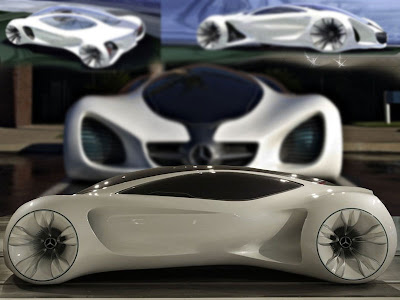
The Mercedes-Benz BIOME is a natural technology hybrid, and forms part of our earth's ecosystem. It grows and thrives like the leaves on a tree" according to Hubert Lee, Head of the Mercedes-Benz Advanced Design Studios in Carlsbad.
Born out of the 2010 LA Auto Show’s Los Angeles Design Challenge, in which automotive designers are given free range to envision the future of transportation, the Biome is meant to blend seamlessly into the planet’s ecosystem. That means all components of the 2010 Biome Concept Mercedes-Benz Concept Cars are “grown” organically, and it emits pure oxygen and is fully compostable at the end of its service life.
2010 Biome Concept Mercedes-Benz Concept Cars
The basis for the Biome Concept is a vehicle that "grows in a completely organic environment from seeds sown in a nursery." Not only that, but it's powered by a combination of the sun and a chemical bond from an imaginary liquid dubbed BioNectar4534. It's all natural, all organic and all science fiction.
This year the competition had called for the creation of a vision of a safe and comfortable 2+2 compact car featuring good handling and a first-class design, and weighing only 1,000 lbs (around 454 kg/kerb weight).
The 2010 Biome Concept Mercedes-Benz Concept Cars symbiosis vehicle is made from an ultralight material called BioFibre and tips the scales at just 875.5 lbs (around 394 kg). This material is significantly lighter than metal or plastic, yet more robust than steel. BioFibre is grown from proprietary DNA in the Mercedes-Benz nursery, where it collects energy from the sun and stores it in a liquid chemical bond called BioNectar4534.
2010 Biome Concept Mercedes-Benz Concept Cars
The 2010 Biome Concept Mercedes-Benz Concept Cars is powered by BioNectar4534, which is stored in the BioFibre material of the chassis, interior, and wheels. In addition, Mercedes-Benz has developed a technology to equip trees with special receptors which can collect the excess solar energy and turn it into BioNectar4534. This creates a direct link with nature's energy sources and acts as an incentive to cover mobility energy requirements through more trees and at the same time maintain natural resources.
The Los Angeles Design Challenge is part of the Design Los Angeles conference, taking place from 17 to 18 November 2010 as part of the Los Angeles Auto Show.
2010 Biome Concept Mercedes-Benz Concept Cars

Wednesday, December 1, 2010

eVaro Hybrid Sports Cars Concept (PHEV) With FVT

eVaro Hybrid Sports Cars Concept (PHEV) With FVT
The new eVaro is a series hybrid, a fully functioning plug-in hybrid electric vehicle (PHEV) with an onboard gas generator, also referred to as an extended-range electric vehicle. While the eVaro is similar to the Chevrolet Volt, the only series hybrid currently confirmed for production (2010), the eVaro (as in “arrow”) has a number of features and performance criteria that will exceed the Volt. These include better aerodynamics (much lower drag coefficient), much less weight, much higher mile per gallon (electric) and a greater range.
The eVaro Hybrid Sports Cars Concept (PHEV) With FVT also compares extremely well with two vehicles from entrepreneurial companies that have received considerable media attention: the $109,000 Tesla and the Aptera. Both of these vehicles are battery electric vehicles (BEV) and, as such, are limited in their operating range because they have to be recharged. “FVT firmly believes that consumers will prefer the security of a series hybrid like the eVaro,” stated George Parker, president of FVT.
eVaro Hybrid Sports Cars Concept (PHEV) With FVT
The makers, Future Vehicle Technologies, say the car is more practical than the electric-only Tesla because it removes the “range anxiety” that comes with an all-electric car. The electric motor can be charged at home in three hours. They claim the car has three wheels instead of four to save fuel and make the car corner better.
Here are some coolest electric vehicles, designed and produced by companies of the United States, Canada and Japan. These electric cars are on display at the 2010 Electric Vehicles Trade Show in Vancouver, Canada, on Sept. 15, 2010.
eVaro Hybrid Sports Cars Concept (PHEV) With FVT
The eVaro is an extended-range electric vehicle that uses a carbon-fiber, Kevlar, and aluminum subframe. Parker claims the car has a 120-130 mile range on electric power, and a total range of 460 miles. The eVaro Hybrid Sports Cars Concept (PHEV) With FVT uses a 1.1-liter, four-cylinder gasoline engine, and it has a total weight of about 2,000 pounds.
The striking eVaro is surprisingly easy to enter, with the large canopy opening wide. There is room for a set of golf clubs to the left of the driver. There is an exterior trunk to the right of the driver and behind the passenger, giving the car more functionality than it might at first appear.
eVaro Hybrid Sports Cars Concept (PHEV) With FVT
The car is one of 43 finalists an entrant in the Automotive X-Prize, a US-based competition that will award $10 million in prizemoney to makers of a super fuel-efficient vehicle. To qualify, each entrant has to be able to achieve 100 miles to the gallon (2.3 litres per 100km), while providing acceptable performance.
FVT hopes to use the publicity surrounding the contest as a springboard to a initial production run of 3000 cars.
eVaro Hybrid Sports Cars Concept (PHEV) With FVT

Share

Twitter Delicious Facebook Digg Stumbleupon Favorites More