Showing posts with label Volkswagen. Show all posts

Monday, May 30, 2011

Steel Drake 2011 Volkswagen Sport Cars Concept By Kyrgyzstanian

Steel Drake 2011 Volkswagen Sport Cars Concept By Kyrgyzstanian
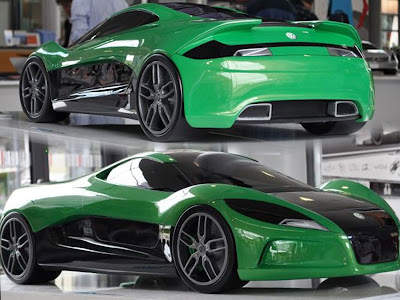
Here are the latest production cars, the Volkswagen Sport Cars Concept, Volkswagen Drake is the type of steel. Steel Drake 2011 Volkswagen Sport Cars Concept By Kyrgyzstanian is a simple but elegant design. Kyrgyzstanian graphic designer “Steel Drake” has created something very much fitting with this scenario in the form of his Volkswagen Sport Cars Concept.
Steel Drake 2011 Volkswagen Sport Cars Concept By Kyrgyzstanian
It resembles a reduced front Motors Audi R8. Then, at halfway of the project, Audi he cans and presents his sketches and model prototyping of Volkswagen decided to put the two doors cut in production. Steel Drake’s Concept Sports cars is a simple-yet-sleek design let down only by some questionable design choices.
Steel Drake 2011 Volkswagen Sport Cars Concept By Kyrgyzstanian
Get for instance the drooping taillights that seem additional befitting a Chinese automobile than 1 built in Germany, or the peculiar concave curves around the doorways that seems caught on as opposed to an integral part of the style. Otherwise it is rather fantastic seeking, although maybe far more something Infiniti would produce than Volkswagen.
Steel Drake 2011 Volkswagen Sport Cars Concept By Kyrgyzstanian

Thursday, February 10, 2011

2011 Volkswagen XL1 (SEV) Roadster Diesel-Electric Hybrid Concept Cars

2011 Volkswagen XL1 (SEV) Roadster Diesel-Electric Hybrid Concept Cars
The latest Volkswagen will unveil, vision becomes reality – Volkswagen’s “Formula XL1”: Volkswagen XL1 prototype consumes just 0.9 l/100 km! Wolfsburg / Doha, 25 January 2011 - Future mobility is one of the most stimulating topics of our time. The key question here: Just how much could the energy consumption of cars be reduced if all the stops were pulled out for efficiency? There is now an answer to this question, and Volkswagen is delivering it in the form of the new XL1. Combined fuel consumption: 0.9 l/100 km. No other hybrid car powered by an electric motor / internal combustion engine combination is more fuel efficient.
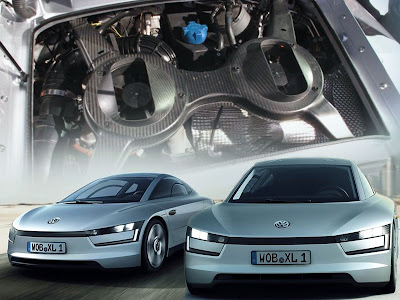
The latest Volkswagen will unveil the 3rd and latest iteration by its roadster diesel-electric hybrid concept serial, the fresh XL1 Super effective Vehicle (SEV) at these week’s Qatar Motor demo, which runs by January 26 to 29. The latest 2011 Volkswagen XL1 (SEV) Roadster Diesel-Electric Hybrid Concept Cars are motivated by a diminished 800 cc TDI two-cylinder basic rail diesel engine breaking 48 HP.
2011 Volkswagen XL1 (SEV) Roadster Diesel-Electric Hybrid Concept Cars
Volkswagen will build small run of XL1 plug-in hybrid in two years. “We want to go into series production with this car starting in 2013,” Volkswagen chairman Ferdinand Piech told Automotive News Europe on Tuesday at an event in Doha, Qatar, ahead of the 2011 Qatar auto show where Volkswagen unveiled an 2011 Volkswagen XL1 (SEV) Roadster Diesel-Electric Hybrid Concept Cars prototype. Pioneering construction techniques, an advanced plug-in hybrid drivetrain and innovative packaging all play a part in allowing the new Volkswagen XL1 Super Efficient Vehicle (SEV) to return 260 mpg on the combined cycle to set a new benchmark for vehicle efficiency.
The new 2011 Volkswagen XL1 (SEV) Roadster Diesel-Electric Hybrid Concept Cars shows the way forward for extreme economy vehicles and clean technologies. It also demonstrates that such cars can also be fun. The feeling when driving the XL1 is truly dynamic - not based on pure power, rather on its pure efficiency. The most efficient car in the world. The new 2011 Volkswagen XL1 (SEV) Roadster Diesel-Electric Hybrid Concept Cars shows the way forward for extreme economy vehicles and clean technologies. It also demonstrates that such cars can also be fun. The feeling when driving the XL1 is truly dynamic - not based on pure power, rather on its pure efficiency. Two examples: 1) To travel at a constant speed of 100 km/h, the prototype only needs 6.2 kW/8.4 PS – a fraction of the performance of today’s cars (Golf 1.6 TDI with 77 kW and 7-speed DSG: 13.2 kW/17.9 PS). 2) In electric mode, the XL1 needs less than 0.1 kWh (82 Wh/km) to complete a one kilometre driving course. These are record values.
2011 Volkswagen XL1 (SEV) Roadster Diesel-Electric Hybrid Concept Cars
Powering the XL1 is a compact 800 cc TDI two-cylinder common rail diesel engine developing 47 hp. It's linked to an electric motor producing 27 hp, resulting in a total of 74 hp - a modest output yet more than enough when the low kerb weight of 1753 lbs (795 kg) of the vehicle is taken into account. Two-cylinder TDI uses mass production technology: The 0.8 litre TDI (35 kW/48 PS) was derived from the 1.6 litre TDI, which drives such cars as the Golf and Passat. The 0.8 TDI exhibits the same data as the 1.6-litre TDI common rail engine in terms of cylinder spacing (88 mm), cylinder bore (79.5 mm) and stroke (80.5 mm). In addition, the Volkswagen XL1 Concept's two-cylinder and the mass produced four cylinder share key internal engine features for reducing emissions. They include special piston recesses for multiple injection and individual orientation of the individual injection jets. The excellent, smooth running properties of the common rail engines were transferred to the two cylinder engine. within addition, a balancer shaft that is driven by the crankshaft turning at the same speed optimises smooth engine running.
When the full power of the hybrid system is engaged, the Volkswagen prototype accelerates from 0 to 100 km/h in just 11.9 seconds; its top speed is 160 km/h (electronically limited). Yet these numbers alone do not tell the whole story: Since the XL1 weighs just 795 kg, the drive system has an easy job of propelling the car. When full power is needed, the electric motor, which can deliver 100 Newton metres of torque from a standstill, works as a booster to support the TDI engine (120 Newton metres torque). Together, the TDI and E-motor deliver a maximum torque of 140 Newton metres in boosting mode.
Carbon fibre reinforced polymer (CFRP) the ideal material for the body of the new 2011 Volkswagen XL1 (SEV) Roadster Diesel-Electric Hybrid Concept Cars because of its light weight. The XL1 Concept weighs only 795 kg. Of this figure, 227 kg represents the entire drive unit, 153 kg the running gear, 80 kg the equipment (including the two bucket seats) and 105 kg the electrical system. That leaves 230 kg, which is precisely the weight of the body - produced largely of CFRP - including wing doors, front windscreen in thin-glass technology as in motorsport and the highly safe monocoque. A total of 21.3 percent of the new 2011 Volkswagen XL1 (SEV) Roadster Diesel-Electric Hybrid Concept Cars, or 169 kg, consists of CFRP. In addition, Volkswagen uses lightweight metals for 22.5 percent of all parts (179 kg). Only 23.2 percent (184 kg) of the new XL1 is constructed from steel and iron materials. The rest of its weight is distributed among various other polymers (e.g. polycarbonate side windows), metals, natural fibres, process materials and electronics.
2011 Volkswagen XL1 (SEV) Roadster Diesel-Electric Hybrid Concept Cars
Design for a new era: The VW XL1 is 3,888 mm long, 1,665 mm wide and just 1,156 mm tall. These are extreme dimensions. The Polo has a similar length (3,970 mm) and width (1,682 m), but it is significantly taller (1,462 mm). The height of the new XL1 is about the same as that of a Lamborghini Gallardo Spyder (1,184 mm). So, it is easy to visualise just how spectacular such a Volkswagen would appear on the road – as long and wide as a Polo, but with a low profile like a Lamborghini. The styling of the XL1 is borne out of functional requirements - easy access to the interior is granted via a pair of elegant scissor doors that hinge on the A-pillar while the profile of the car has been honed in the wind tunnel, the result being a remarkable coefficient of drag figure of 0.186. The XL1's overall length and width are similar to those of a Volkswagen Polo yet its height is more akin to that of a Lamborghini Gallardo Spyder. Although the XL1 is still very much a concept, its unveiling marks the next step towards the birth of a new class of Super Efficient Vehicles, while the advent of a process such as RTM is a significant milestone.
2011 Volkswagen XL1 (SEV) Roadster Diesel-Electric Hybrid Concept Cars

Monday, August 23, 2010

2010 Solar Powered Supercar Volkswagen Concept Car

Volkswagen supercar presented at the 2010 Swansea Metropolitan University Degree Show in automotive design by Peter Wilkins not only promises to run by solar power with greater efficiency but also offers a competitive design styling. The “VW Solar Powered Supercar” by designer Peter Wilkins is a car concept that demonstrates the aesthetic aspect of eco-friendly vehicles to attract more people toward sustainable commuting.
2010 Solar Powered Supercar Volkswagen Concept Car
Peter Wilkins’ design is one of the sexiest eco-cars I have ever seen. Making earth-friendly cars that look good is a great idea. Peter Wilkins has designed one helluva eco-friendly car for the 2010 Swansea Metropolitan University Degree Show. His supercar would run off of an electric motor powered by photovoltaic cells, or a hydrogen fuel cell stack. It is a luxury supercar, it will only be built in a limited number of 200 units. It was designed to be able to cruise around in the year 2020.
The unique design of Wilkins permits each of the four wheels of the vehicle to be driven by an independent electric motor powered by solar energy stored in photovoltaic (PV) cells. The upper external surface of the vehicle stores the PV cells that further supply power to the mid-mounted hydrogen fuel-cell stack, which is directly linked to the electric motors. Placement of the PV cells and hydrogen fuel-cell stack form an integral part of the elegant design of the eco car that looks like part of a supercar.
Simply known as the “VW Solar Powered Supercar”, this vehicle shows how just clean and green travel can get, and fast too. To power up, the car turns its face away from the smelly gas pump and integrates photovoltaic cells in its body instead. It uses these to juice up with solar power.
The energy generated is used to power up a mid-mounted hydrogen fuel cell stack, resulting in a drive without the smoke and the pitch-black carbon footprint supercars usually leave behind these days.
2010 Solar Powered Supercar Volkswagen Concept Car

Friday, August 13, 2010

2010 Up! Lite Concept Volkswagen Diesel Electric Hybrid Concept Car

The new concept, based on Volkswagen’s New Small Family (the Up! models), incorporates a variation on the two-cylinder TDI hybrid powertrain from the L1 concept unveiled earlier this year at the Frankfurt Motor Show. This small turbo-diesel hybrid possesses a small physical footprint--being much smaller than the VW Golf--and a super small carbon footprint, reaching an astronomical 70 US mpg fuel economy on the EU testing cycle. Volkswagen staged the world premiere of the Up! Lite concept at the LA Auto Show.
The Up! Lite concept continues the Volkswagen strategy of offering high-tech and high-end quality in all of its vehicle classes, making progress affordable for every car driver. The Up! Lite was designed to be a versatile vehicle that makes trips into the city, commutes to work and naturally long trips as well significantly less expensive and more eco-friendly.
Naturally, on the Up! Lite there is nothing lacking in comfort or safety. ESP is on board, airbags are on board, ample space is on board, highly advanced information and control features are on board, and it is good to know that occupants are enclosed and protected by a highly innovative safety frame of aluminium, steel and carbon fiber.
The Volkswagen concept has a top speed of 160 km/h (100 mph) and accelerates to 100 km/h in a respectable 12.5 seconds (0-60 mph in 12 seconds). The Volkswagen Up! Light with its extremely efficient engine might be the perfect example to exemplify this. Ultra light (less than 700 kilograms / around 1,500 pounds) it achieves a mileage of 2.44 liters for a 100 km (70 MPG).
The centerpiece of the Up! Lite powertrain is the newly designed 0.8 TDI two-cylinder turbo-diesel engine with a power of 38 kW / 51 PS. Furthermore, the electric motor (10 kW) – designed as a pulse start module (starter, alternator and E-drive) – also reduces the load of the TDI, provides added propulsion (boosting) and works to recover kinetic energy (regenerative braking). During boost phases – e.g. in a quick passing maneuver – the TDI and E-motor combine for a total power of 48 kW / 65 PS. Incidentally, a version of the TDI used in the Up! Lite was also used aboard the L1 concept car that Volkswagen presented in September at the IAA Motor Show in Frankfurt.
2010 Up! Lite Concept Volkswagen Diesel Electric Hybrid Concept Car
In two of its operating phases, the hybrid drive of the Up! Lite was designed to operate without any TDI propulsion at all. First phase: In so-called coast-down, activated by the driver taking his or her foot off the gas pedal (car coasts, TDI engine is shut off). Second phase: Over shorter distances, e.g. in residential areas, the E-motor can power the Up! Lite all by itself. In this case, a lithium-ion battery supplies the energy. Since it is capable of pure electric driving, the configuration is classified as a full hybrid. Shifting work is handled by a 7-speed Direct Shift Gearbox (DSG) like the one used in the new Polo. Moreover, the Volkswagen is equipped with a Stop-Start system.
The Up Lite concept is the harbinger of Volkswagen's new small car platform that should bear fruit in the form of a production Up Lite as early as the second half of 2011.

Sunday, July 4, 2010

2010 Kai-Nalu Volkswagen Concept Car by Josep Ferriol

Josep Ferriol is a graduate of Universidad Politécnica de Valencia in Spain, and a designer. He created this concept design called the Volkswagen Kai-Nalu, a wild child with extremely exotic looks, as part of his thesis.
The main inspiration came from the waves of the Mediterranean sea. The flowing glass section is styled after the sea, while the lower body got its inspiration from rocks as they get hit by crashing waves.
Ferriol is quite aware of how bold and probably controversial the Kai-Nalu would be, given the tendency for certain modern cars to follow similar design patterns.
The Volkswagen Concept Josep Ferriol includes the clear roof, highly stylised wheels and an electric drivetrain with two separate motors and design of Kai-Nalu is somewhat controversial and certainly no please everyone. But in a world where there are many supercars that follow the same formula and same style, the Volkswagen Kai-Nalu is refreshing and different.
Designed to be powered by a zero-emission electric engine, the vehicle features highly stylized wheels which have been inspired by the appearance of bicycle wheels.

Share

Twitter Delicious Facebook Digg Stumbleupon Favorites More